The Impact of Arizona's Property Tax Cycles on Your Monthly Debt-to-Income Ratio
MW
Margaret Wack
Personal Finance Writer · Updated October 2026

Margaret Wack
Personal Finance Writer · Updated October 2026
Imagine you are a homeowner in Maricopa County. You have spent the last three years budgeting perfectly, maintaining a steady monthly cash flow that allows for a comfortable lifestyle. Suddenly, you receive your new assessment notice, and due to the local property tax revaluation cycle, your annual obligation has jumped by 15 percent. While this might feel like a temporary sting in your wallet, it could have much more significant implications for your financial flexibility. In 2026, as many Arizona residents navigate shifting economic landscapes, understanding how these fluctuations impact your Debt-to-Income (DTI) ratio is crucial for anyone considering new credit.
Your DTI ratio is a fundamental metric used by lenders to determine your ability to manage monthly payments. It is calculated by dividing your total monthly debt obligations by your gross monthly income. When your property taxes rise, that numerator increases, which can potentially lower the amount of credit you qualify for in 2026. For example, if you are looking at a personal loan with an APR ranging from 10% to 35% depending on your profile, even a small increase in monthly overhead could push your DTI above the threshold preferred by many lenders.
This article is designed to help you navigate these seasonal and cyclical shifts. We will explore how Arizona's unique tax timeline works, how to calculate the impact of these changes on your borrowing power, and what specific steps you can take to protect your creditworthiness. By the end of this guide, you should have a clear framework for managing your property-related expenses while keeping your DTI in optimal shape for future financial goals.
In Arizona, property tax assessments are not static. Counties like Maricopa and Pima operate on specific revaluation cycles where the assessed value of your home is updated to reflect current market conditions. In many cases, these updates can lead to significant jumps in your annual tax bill between years. For a borrower, this isn't just about having less money for groceries; it is about how that expense is categorized when you apply for credit.
When lenders evaluate your application, they often look at total monthly obligations. Even if you do not pay your property taxes as part of an escrowed mortgage payment, many sophisticated lenders will calculate a 'pro-rated' monthly tax amount to include in your DTI calculation. This ensures that the lender sees your true cost of living. If your home value has spiked due to local demand, your DTI could look much higher on paper than it actually feels in your day-to-day cash flow.
Consider this scenario: A homeowner has a gross monthly income of $5,000 and existing debt payments (car loan, student loans) totaling $1,200. Their current DTI is 24 percent. After an Arizona tax revaluation, their annual property tax increases by $1,800. That's an extra $150 per month. Suddenly, their calculated monthly obligation rises to $1,350, pushing their DTI to 27 percent. While a jump from 24% to 27% might seem minor, it can be the deciding factor if you are applying for multiple lines of credit simultaneously in 2026.
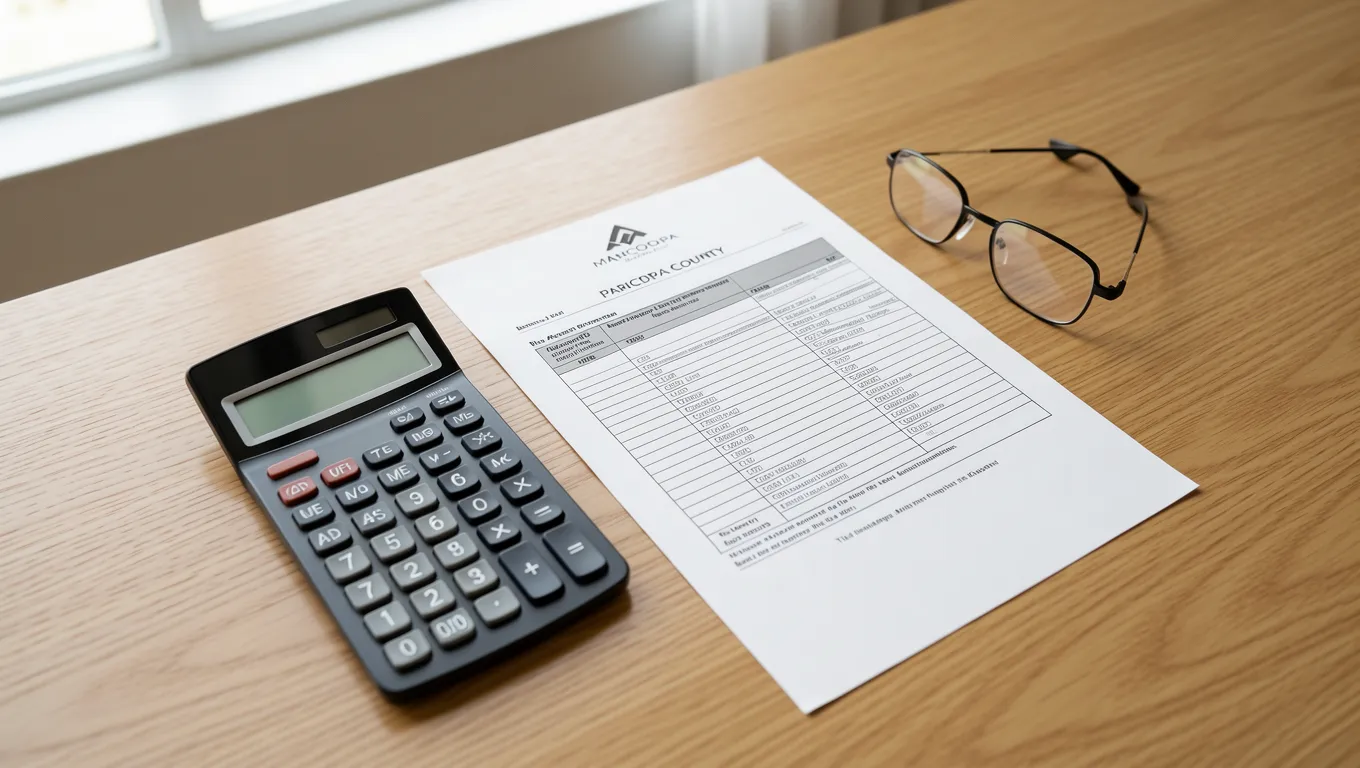
To master your finances, you must move beyond 'gut feelings' and start using hard math. Understanding the mathematical relationship between your tax bill and your loan eligibility is a superpower in personal finance. Many borrowers make the mistake of only looking at their mortgage payment, but for those with variable property taxes or those who pay directly to the county, the calculation requires more nuance.
Let's walk through three practical examples to illustrate how these numbers behave in different scenarios:
Arizona's tax payment schedule is not always a smooth, monthly stream. Depending on your county and how you choose to pay, you might be looking at semi-annual or even annual lump sums. This 'lumpiness' in cash flow can create a deceptive sense of financial stability during the months when no payments are due, only to cause a crisis when the bill arrives.
Lenders look for consistency. If your bank statements show large, irregular outflows every six months to pay property taxes, it may signal volatility to an underwriter. This is why many experts recommend 'smoothing' these costs by setting aside 1/12th of your annual tax bill each month in a dedicated savings account. This approach mimics a monthly debt obligation and provides a much more stable profile for credit applications.
One nuance often missed is the timing of your application. If you apply for a personal loan in March, but your large property tax payment is due in May, a lender might ask for documentation regarding that upcoming liability. Never assume that because you have cash in the bank today, your DTI is safe; lenders are looking at what you owe, not just what you have. Always align your credit applications with periods of stable, predictable cash flow to maximize your chances of success.
Timing is everything when managing debt in Arizona. Because property tax assessments and payment cycles follow a predictable rhythm, you can use that knowledge to your advantage. If you know a revaluation is coming or a large tax installment is due, there are specific strategies you should employ to keep your DTI healthy.
First, consider the 'Pre-Application Audit.' Before applying for any new credit in 2026—whether it is a personal loan for home renovations or a car loan—perform a full audit of your expected tax obligations for the next twelve months. If you see a significant spike coming, you might choose to delay your application until after that obligation is settled and reflected as 'paid' in your financial history.
Second, utilize the power of an emergency fund specifically for taxes. Rather than using high-interest credit cards to cover a tax hike, which would drastically increase your DTI through new revolving debt, use a dedicated 'Tax Buffer.' This buffer acts as a shock absorber, ensuring that a sudden assessment change doesn't turn into a permanent debt problem. By managing the tax cycle proactively, you maintain control over your financial narrative rather than letting the county dictate your creditworthiness.
There are two primary ways to handle property taxes in Arizona, and each carries different implications for your DTI and cash flow. Choosing the right method depends on your personal discipline and your long-term financial goals.
Option A: The Escrow Method (via Mortgage). In this scenario, your lender collects a portion of your tax bill every month as part of your mortgage payment.
Option B: Direct Payment Method. You pay the county directly, usually in one or two large installments per year.
When deciding between these two, consider your upcoming plans for 2026. If you are planning to apply for a large personal loan soon, the Escrow Method might offer more stability and predictability for an underwriter, even if it feels slightly less flexible in the short term.
The 'DTI Trap' occurs when a borrower focuses so heavily on their monthly income that they forget to account for the total weight of their obligations. In Arizona, where property values can fluctuate rapidly, this trap is particularly dangerous. A sudden increase in your home's assessed value might feel like an increase in wealth (equity), but it simultaneously increases your liability (taxes).
To avoid this, follow this simple decision framework when evaluating a new loan application: